These Clubs Are Developing Europe’s Best Young Players

A few weeks ago, I wrote about one of the surprises of this summer’s FIBA Youth EuroBaskets.
Slovenia won U18 and U20. Latvia won U16. Three titles for countries with populations of roughly 2 million.
While working on that article, I kept coming back to another thought.
A national-team jersey tells us which country a player represents during the summer. But it doesn’t tell us where he spends the rest of the year learning the game.
So I decided to turn the question around.
Which clubs had the most players competing at this summer’s U16 and U18 European Championships?
As part of my analysis of the FIBA Youth EuroBaskets, I combined the Division A and B rosters and traced the players back to their clubs.
This is what came out:
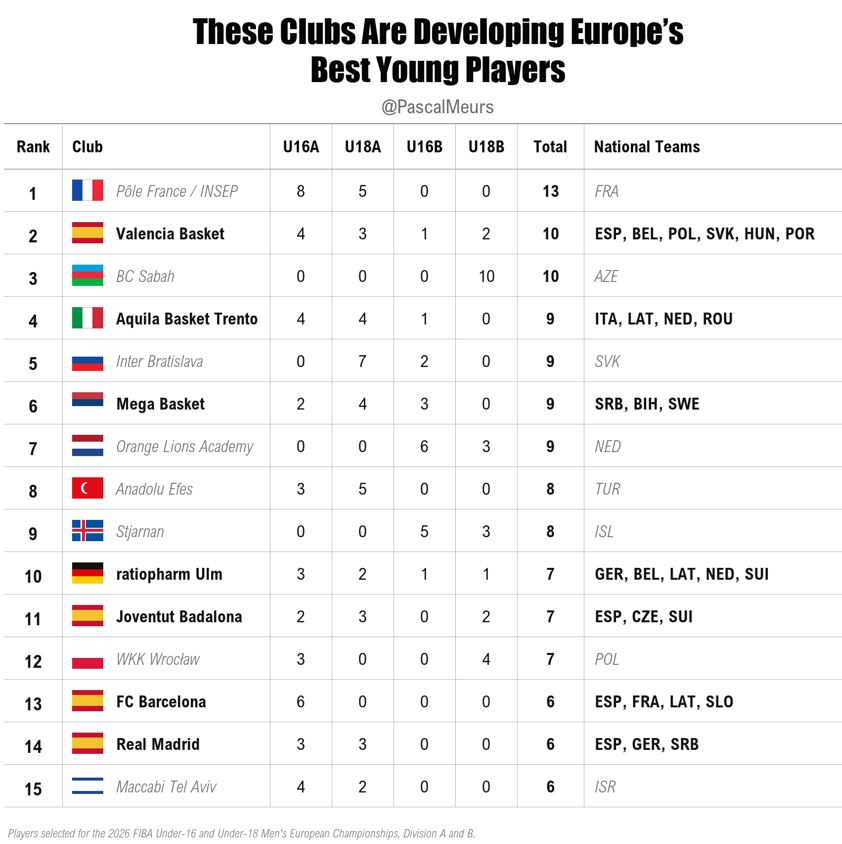
The number one needs an asterisk.
Pôle France / INSEP had thirteen players, but INSEP isn’t a traditional club academy. It is the French federation’s national development programme. The same goes for the Orange Lions Academy in the Netherlands.
Then there is BC Sabah with ten players, all representing Azerbaijan. Inter Bratislava had nine Slovakian players.
Interesting. But I was particularly curious about something else.
Which clubs are developing players for different nations?
And that is where Valencia Basket stands at the top.
Ten players, representing six different countries.
Valencia is not alone. Mega Basket had players representing Serbia, Bosnia and Herzegovina and Sweden. Aquila Basket Trento had players from four different countries. Ratiopharm Ulm from five.
Four Spanish clubs appear in this Top 15: Valencia Basket, Joventut Badalona, FC Barcelona and Real Madrid. In my previous analysis, Spain had already emerged as the most common European destination for youth prospects.
At this point I should probably disclose that I am slightly biased.
I spent three seasons coaching Valencia Basket’s elite U16 boys, with L’Alqueria del Basket as my everyday workplace.
Alqueria is the Valencian word for a traditional farmhouse. I have always found that a wonderfully appropriate name for a place built around growing basketball talent.
And Valencia made that idea very tangible. Inside L’Alqueria there is the Mur dels Somnis — the Wall of Dreams. I wrote about it on this blog years ago, after attending one of its ceremonies. Players who spend at least three years in the youth programme and eventually make their first-team debut earn their name on that wall.
For the hundreds of kids practicing underneath the same roof, the pathway is literally there for them to see.
The facilities are extraordinary, of course. But facilities don’t develop players. Environments do.
This ranking doesn’t prove which academy is “the best” in Europe. Players move, development takes years, and these championships are only a snapshot.
But it does reinforce a belief I have had for years: “Spain has the best youth development in the world.”
That belief was probably the #1 reason I moved to Spain several years ago.
So no, this ranking doesn’t really surprise me at all.
In one of my next articles, I’ll take a closer look at how different European countries organise youth development — and how Spain sets itself apart.


Beste Pascal. Ik denk dat er van jouw analyse over bij welke clubs/opleidingen/Academies spelers vandaan komen een perverse prikkel uitgaat. In elk geval werkt het op die manier in Nederland met dit soort lijstjes.
Clubs/Opleidingen/Academies zien dit als de ultieme bevestiging van de kwaliteit van hun opleiding net als de banners van kampioenschappen die ze ophangen in hun thuishal.
Veel clubs in Nederland zijn vooral aan het recruteren in plaats van echt opleiden. Ze ruilen jonge spelers na een seizoen maar al te graag in voor nieuwe spelers.
Wanneer een 18 jarige speler 5-7 jaar bij 1 club gedegen is opgeleid en 1 jaar bijvoorbeeld bij Orange Lions Academy heeft gezeten dan krijgt Orange Lions Academy de credits….
Bovendien is Orange Lions Academy een door de NBB en NOC Nsf betaalde organisatie die grote invloed heeft op welke spelers er in de nationale jeugd EK’s actief zijn. Ze selecteren zelfs spelers die uiteindelijk nauwelijks op een jeugd EK spelen wat voor mij de bevestiging is van het feit dat dit soort lijstjes niets zegt en men er zelfs verkeerde conclusies aan kan verbinden.
Wist je trouwens ook dat NOC Nsf in Nederland ook Orange Lions Academy een prestatie-beloning geeft voor iedere speler die ze naar het buitenland brengen?
Ik vind dat je pas kunt spreken van een speler die bij 1 club/opleiding/academy is opgeleid wanneer hij daar minimaal 2 jaar is geweest.
Sportieve groet,
Carlo Rizzone
Coach LandsLakeLions U19 Eredivisie
Nederland
Bedankt voor je reactie, maar ik vind dat je hier een aantal zaken door elkaar haalt.
Ik heb onderzocht bij welke clubs de spelers van de Europese U16- en U18-kampioenschappen actief zijn. Dat zijn objectieve gegevens. Ik heb nergens beweerd dat de clubs in deze ranking al die spelers zelf hebben opgeleid, laat staan dat dit een ranglijst van de beste jeugdopleidingen is.
Dat je mijn onderzoek vervolgens een ‘perverse prikkel’ noemt, vind ik bijzonder kort door de bocht. Als bepaalde clubs zulke cijfers gebruiken om zichzelf ten onrechte als de beste opleiding te presenteren, zegt dat iets over die clubs. Niet over de waarde van het onderzoek.
Je kritiek op Orange Lions Academy kan terecht zijn, maar ik voel geen enkele behoefte om hun selectiebeleid, financiering of werking te verdedigen. Dat staat volledig los van de vraag die ik onderzocht heb.
Ik ben het met je eens dat recruitment en player development twee verschillende zaken zijn. Maar precies daarom vind ik het belangrijk om meer inzicht te krijgen in waar jonge internationals spelen, hoe ze zich verplaatsen en hoe verschillende landen en clubs hun jeugdwerking organiseren.
Dat je op basis van mogelijke verkeerde interpretaties concludeert dat zulke lijstjes niets zeggen, vind ik moeilijk te begrijpen. Volgens mij hebben we in het Europese jeugdbasketbal juist méér onderzoek en objectieve gegevens nodig, niet minder.
Kritiek op de interpretatie van data is altijd welkom. Maar laten we het onderzoek beoordelen op wat het daadwerkelijk onderzoekt, niet op conclusies die er niet in staan.
Sportieve groeten
Very interesting. Bedankt Pascal
Je serais aussi intéressé de savoir comment le lien avec l’école est organisé de 14 à 18 ans dans ces clubs/académies.
Il y a également une telle différence physique entre certains joueurs du même âge sur un même continent entre pays différents qui saute aux yeux. Comment l’expliquer ? Essayer de voir le planning de travail sur un mois par exemple ( basket/physique/école) entre des joueurs u16 de Serbie/Lettonie/Espagne/Belgique/Allemagne pourrait également être intéressant.
Merci pour ton retour ! Ce sont effectivement des questions très intéressantes, notamment sur l’équilibre entre le basket, la préparation physique et l’école.
J’espère pouvoir approfondir certains de ces sujets dans mes prochains articles.