The Summer of the Small Nations in European Basketball?
The summer of FIBA national team basketball has come to an end. And at the men’s European youth championships, one observation stood out.
Slovenia won U20.
Slovenia won U18.
Latvia won U16.
Both countries have around … two million inhabitants.
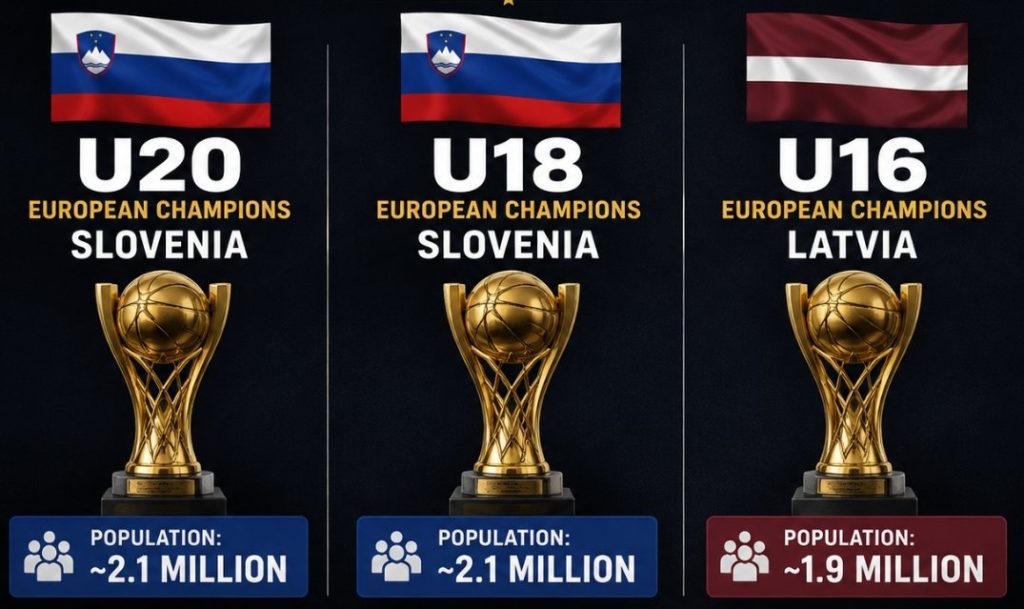
Not immediately what you would expect. Nations with a bigger initial talent pool inevitably have an advantage. It is, at least partly, a numbers game.
Spain and France, for example, were the only countries to reach the semifinals in all three age categories, while Greece and Germany finished in the Top 8 every time.
But that’s exactly why the success of these small nations this summer is so powerful. It removes one particularly easy excuse: the numbers.
A smaller theoretical talent pool should not give you smaller ambitions.
There must be lessons in there for every federation working with a smaller talent pool.
I wanted to know what they were.
Through an agreement with FIBA, I have the opportunity to analyse this summer’s youth championships in much more detail.
So before diving into playing styles and tactical trends, I decided to take a closer look at where these players spend their daily basketball lives.
Winning a European Championship tells us who built the best national team that summer. But does it also tell us where Europe’s best young players are being developed?
For every player at the U16 and U18 Division A championships, I looked at something very simple: in which country is his club located?
The dataset contains 384 player-tournament records. Club information was unavailable for 38 of them.
And once I plotted the remaining records, one country immediately stood out: Spain.
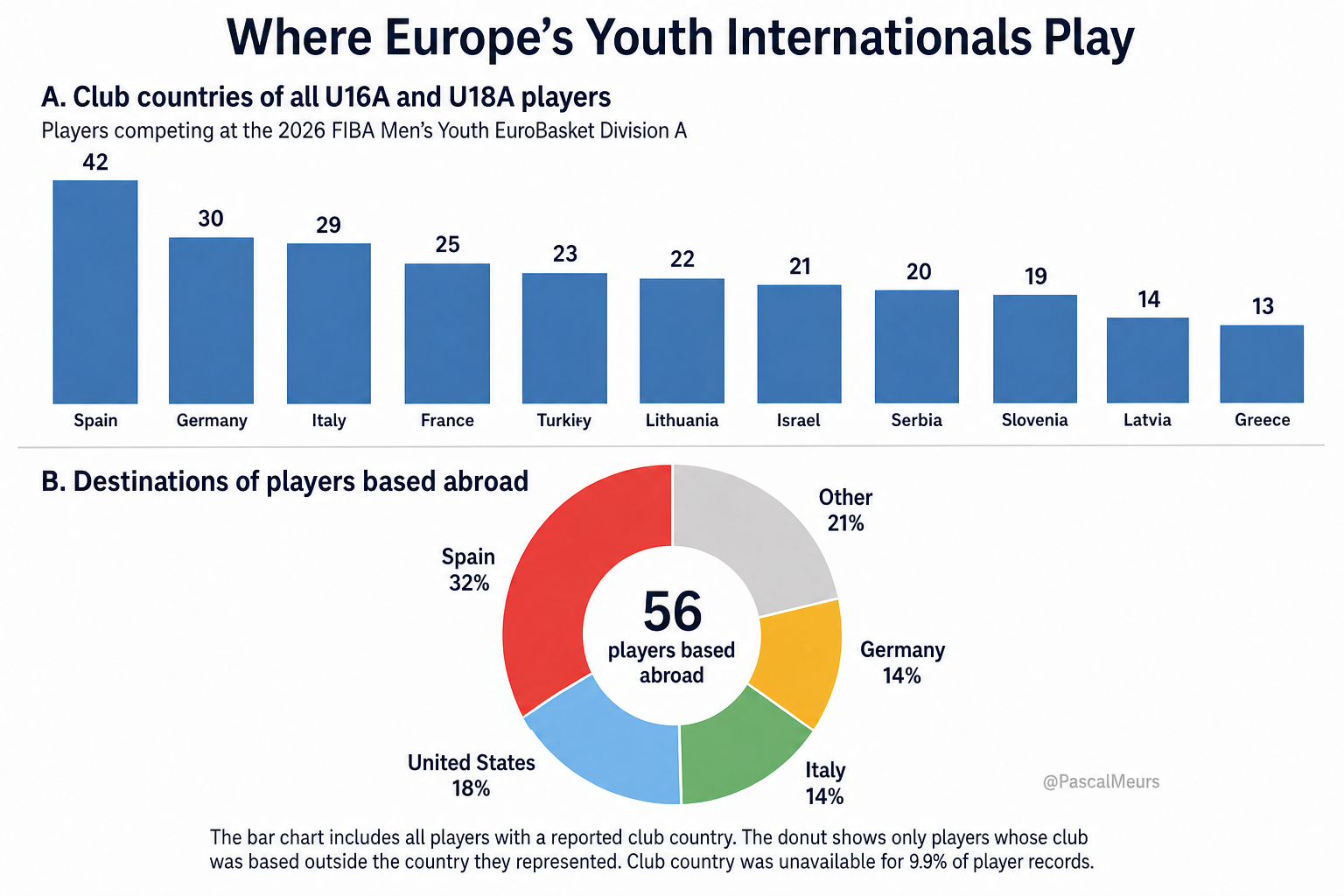
That first graph, however, can be misleading if read too quickly. A country participating in both tournaments will automatically accumulate many records when most of its national-team players stay at home.
So I asked a second question: where do players go when they leave their own country?
There were 56 foreign-based player records, and eighteen of them were playing in Spain — almost one in three.
Another ten were playing in the United States. Spain and the US together therefore accounted for exactly half of all foreign-based players in these two championships.
Slovenia and Latvia unquestionably owned the podium this summer. Their success is a wonderful reminder that population does not dictate ambition or results.
But a national-team jersey only tells us which country a player represents. It does not necessarily tell us where he spends the other ten months of the year learning the game.
Those are two different maps of European basketball.
This summer, the smaller nations won the medals. Behind those national flags, however, sits a much wider network of clubs, academies and federation programmes.
There are lessons to be learned from both.
Over the next few weeks, I want to find out what they are.