Two Ways to Manage 40 Minutes
Why Valencia–Olympiacos deserves a closer look.
Last season, I wrote about the different rotation philosophies in the EuroLeague.
Paris had been taking an unusual approach for several years: frequent substitutions, short appearances and a remarkably structured rotation pattern. The idea behind it was to sustain intensity throughout the game.
Valencia was successful last season, embracing a similar approach.
Over the past year, I started noticing shorter rotations elsewhere too — in other leagues and during the FIBA windows.
But with mixed results.
Because there is more to it than sending players to the scorer’s table every three minutes. Roster depth matters. Player acceptance matters. So do the level of competition and the type of basketball you want to play..
That made me curious about the new EuroLeague season.
Then I watched Olympiacos.
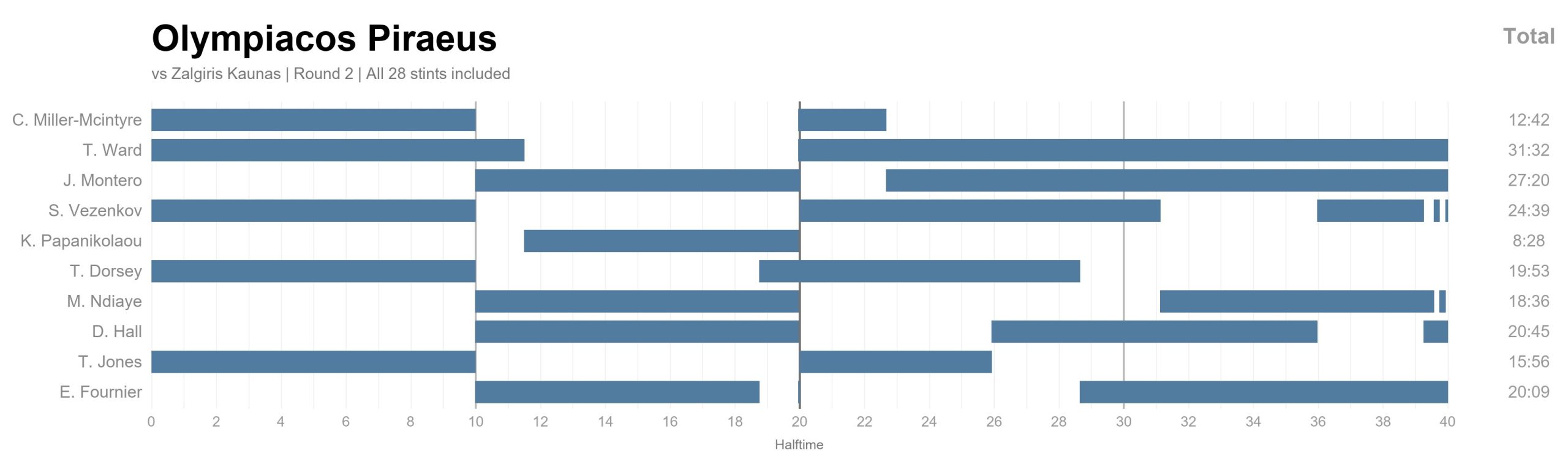
Against Žalgiris, Georgios Bartzokas did not make a single substitution during the first quarter. All five starters played the full ten minutes.
At point guard, Codi Miller-McIntyre played the opening quarter. Jean Montero took the entire second. Montero later returned with 7:20 remaining in the third and stayed until the final buzzer.
Tyson Ward played the complete second half without coming out.
This is what that looks like:
Now compare it with Paris against ASVEL:
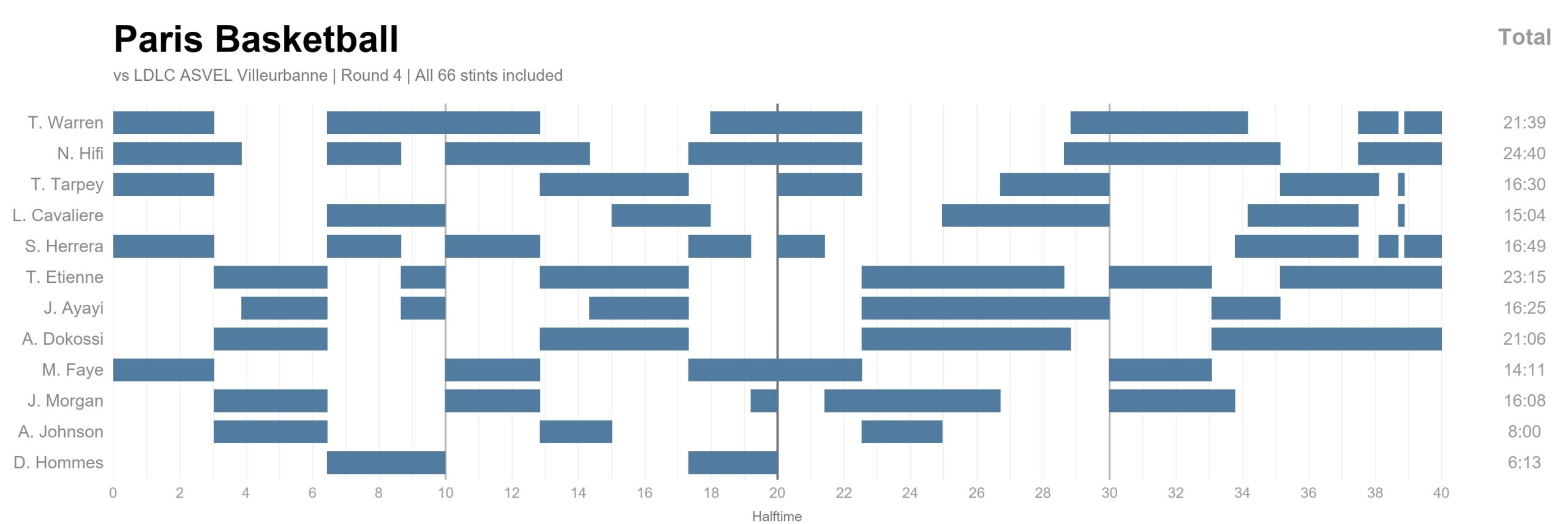
Twenty-eight player stints in the Olympiacos example. Sixty-six for Paris.
Different games, of course. But two very different ways to organise forty minutes.
Think of two directors editing a film. One builds the sequence through quick cuts. The other lets the scene breathe.
The shorter rotations appearing elsewhere have certainly not made everyone converge towards the same model.
Both philosophies remain very much alive. And neither comes with a guarantee of better results.
There is another detail worth considering: how those rotations organise time on the bench.
Against Valencia, Milano’s Zach LeDay played 17:28, divided into just two appearances. The opening four minutes, followed by more than 22 minutes of uninterrupted game-clock time on the bench, before returning for the final thirteen minutes.
Halftime and stoppages made that wait even longer.
As a coach, I wonder how you prepare a player for that return. Staying ready for one possession is one thing. Returning after such a long break to play thirteen consecutive minutes is another.
The minutes total alone never tells you that story.
Here is the picture for all twenty teams after four rounds:
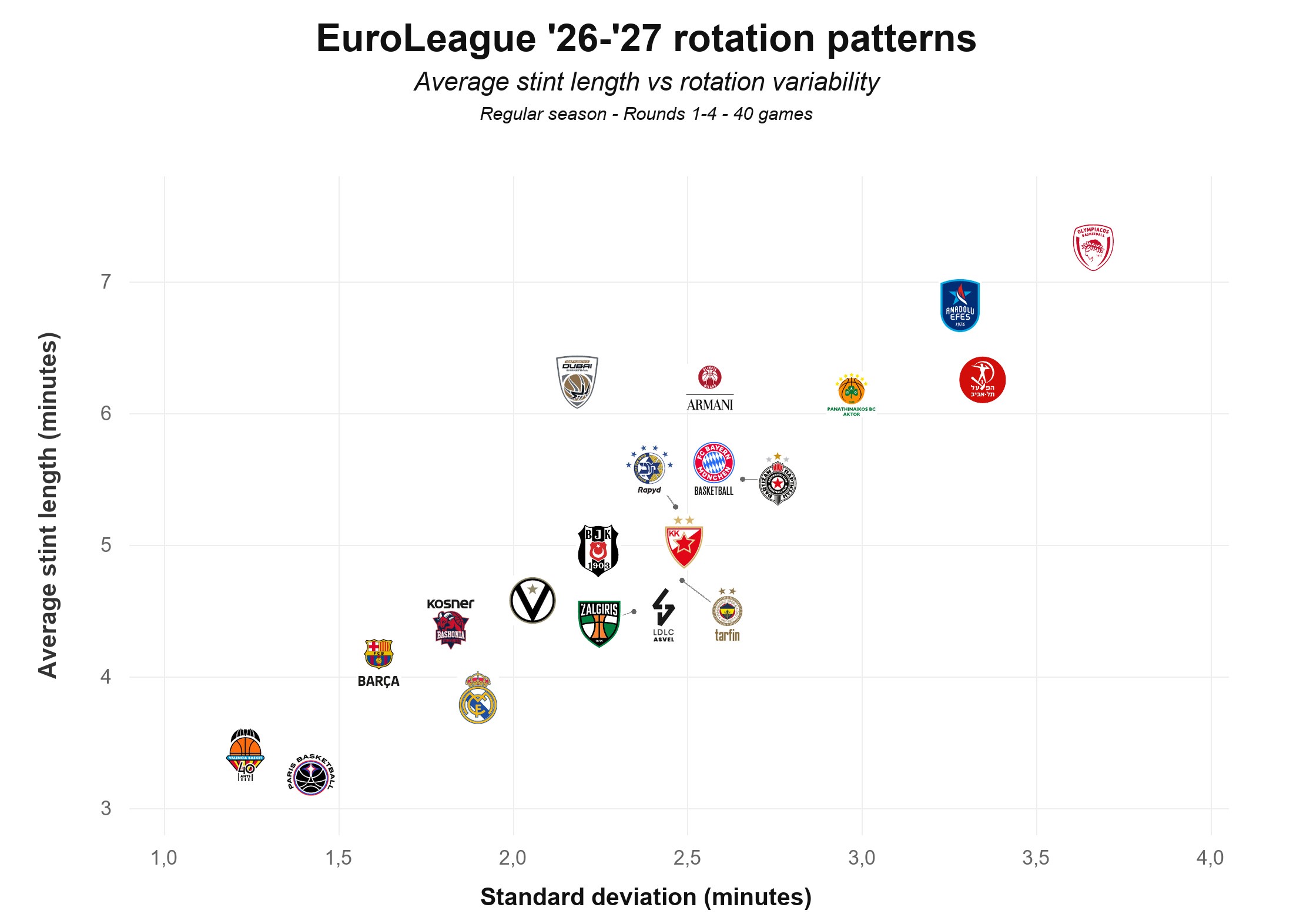
Paris and Valencia remain at the short-stint end. Olympiacos sits at the opposite extreme.
Real Madrid has moved towards shorter appearances under Pedro Martínez, consistent with the approach he used at Valencia. Valencia under Xavi Albert remains close to Paris. Xavi Pascual’s Dubai, meanwhile, sits towards the longer-stint end, alongside Pablo Laso’s Efes and Dimitris Itoudis’ Hapoel Tel Aviv.
Four games per team is an early snapshot. Enough to recognise contrasting approaches. Far too early to decide which works better, or whether the distance between them will keep growing.
Tomorrow, Valencia hosts Olympiacos. Second against third, with two contrasting rotation philosophies on the same court.
Keep an eye on the bench.