These Clubs Are Developing Europe’s Best Young Players

A few weeks ago, I wrote about one of the surprises of this summer’s FIBA Youth EuroBaskets.
Slovenia won U18 and U20. Latvia won U16. Three titles for countries with populations of roughly 2 million.
While working on that article, I kept coming back to another thought.
A national-team jersey tells us which country a player represents during the summer. But it doesn’t tell us where he spends the rest of the year learning the game.
So I decided to turn the question around.
Which clubs had the most players competing at this summer’s U16 and U18 European Championships?
As part of my analysis of the FIBA Youth EuroBaskets, I combined the Division A and B rosters and traced the players back to their clubs.
This is what came out:
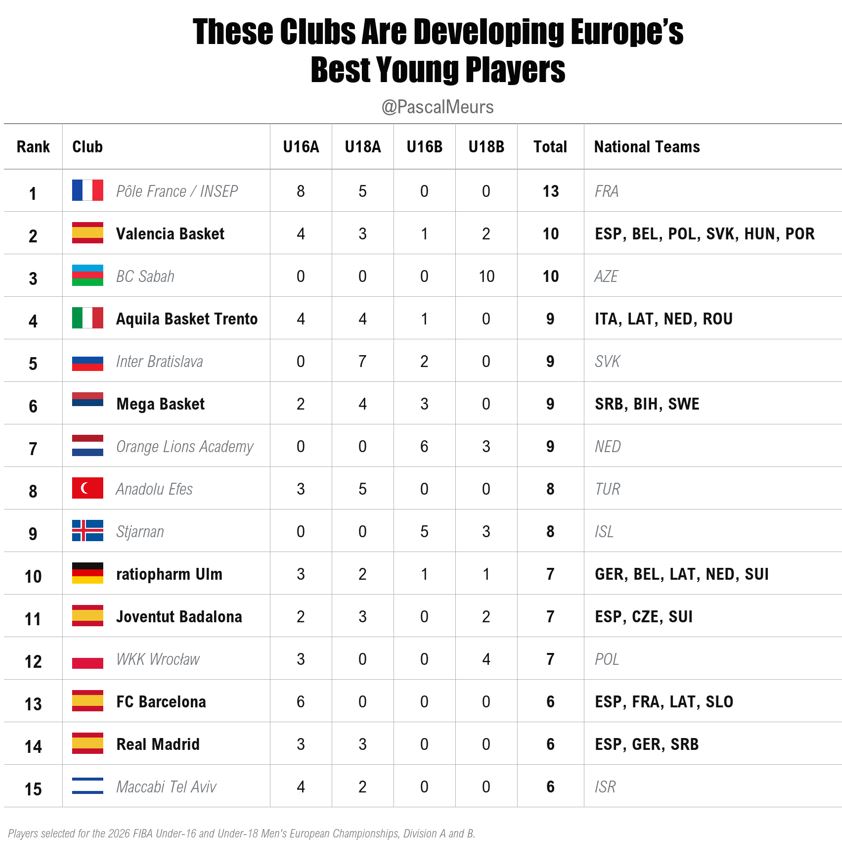
The number one needs an asterisk.
Pôle France / INSEP had thirteen players, but INSEP isn’t a traditional club academy. It is the French federation’s national development programme. The same goes for the Orange Lions Academy in the Netherlands.
Then there is BC Sabah with ten players, all representing Azerbaijan. Inter Bratislava had nine Slovakian players.
Interesting. But I was particularly curious about something else.
Which clubs are developing players for different nations?
And that is where Valencia Basket stands at the top.
Ten players, representing six different countries.
Valencia is not alone. Mega Basket had players representing Serbia, Bosnia and Herzegovina and Sweden. Aquila Basket Trento had players from four different countries. Ratiopharm Ulm from five.
Four Spanish clubs appear in this Top 15: Valencia Basket, Joventut Badalona, FC Barcelona and Real Madrid. In my previous analysis, Spain had already emerged as the most common European destination for youth prospects.
At this point I should probably disclose that I am slightly biased.
I spent three seasons coaching Valencia Basket’s elite U16 boys, with L’Alqueria del Basket as my everyday workplace.
Alqueria is the Valencian word for a traditional farmhouse. I have always found that a wonderfully appropriate name for a place built around growing basketball talent.
And Valencia made that idea very tangible. Inside L’Alqueria there is the Mur dels Somnis — the Wall of Dreams. I wrote about it on this blog years ago, after attending one of its ceremonies. Players who spend at least three years in the youth programme and eventually make their first-team debut earn their name on that wall.
For the hundreds of kids practicing underneath the same roof, the pathway is literally there for them to see.
The facilities are extraordinary, of course. But facilities don’t develop players. Environments do.
This ranking doesn’t prove which academy is “the best” in Europe. Players move, development takes years, and these championships are only a snapshot.
But it does reinforce a belief I have had for years: “Spain has the best youth development in the world.”
That belief was probably the #1 reason I moved to Spain several years ago.
So no, this ranking doesn’t really surprise me at all.
In one of my next articles, I’ll take a closer look at how different European countries organise youth development — and how Spain sets itself apart.

Very interesting. Bedankt Pascal