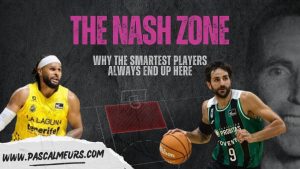
The Nash Zone – Why The Smartest Players Always End Up Here
The NBA Finals ended last night.
In Spain, they are still playing.
The ACB semifinals are not over yet. And before Ricky Rubio and Patty Mills close their seasons, there is something worth paying attention to.
Not the highlight passes. Not the floaters. Not the assists that make the crowd react.
Something smaller. And far more important.
Watch either of them for a full game and at some point they disappear. Not from the game. From where you expect them to be.
The possession looks ordinary. The defense is set. The ball handler seems to be going nowhere in particular. Then — a few dribbles later — the defense is completely compromised.
That area has a name.
The Nash Zone.
The space behind the backboard, between the baseline and the two blocks. Steve Nash made it famous. But what Nash understood — and what Rubio and Mills still understand — is that this is not just a spot on the floor. It is a decision-making tool.
When the ball enters the Nash Zone, the first effect is predictable: the defense collapses. Eyes follow the ball. The paint fills. And that alone already creates value.
But the real advantage comes one step later.
When a ball handler drives toward the rim, defenders feel immediate danger. When that same player dribbles away from the rim — and especially behind the basket — the defense relaxes for a fraction of a second.
They think the threat is gone.
That is usually when it begins.
Because what happens in the Nash Zone is essentially a ball reversal without a pass. Strong side becomes weak side. Weak side becomes strong side. Help responsibilities shift in the middle of the action. And in that brief moment of confusion, cutters open, corners clear, and elite decision-makers find exactly what they were looking for.
This is not about physical tools. Neither Rubio nor Mills ever relied on athleticism to create.
What they have is patience. And an understanding that sometimes the best way to attack the basket is to go behind it first.
Young players love the final pass. Coaches love the advantage that created it.
The video below shows several examples from these ACB semifinals. Different games, different teams, same principle.
The smartest players always end up here.
Interested in the ACB? Earlier this season I published a free report on the latest trends in Spanish basketball and how data can support coaching decisions at the highest level: