Same Age. Twice the Experience.
How Spain Produces Competitors
After this past summer’s Youth EuroBaskets, I found myself having recurring conversations about Belgian basketball, following a disappointing summer for the boys’ national teams.
It never takes long before Spain comes up. The explanation often sounds something like this: “They know how to compete. They are a tournament team.”
I understand what people mean. But how does a player become good at playing tournaments?
Recently, I was talking to a friend who coaches one of Belgium’s top U16 teams. I asked him how many games his team had played during the entire season. League games, tournaments, friendlies. Everything included.
Twenty-nine.
I was shocked. I spent three seasons coaching Valencia Basket’s elite U16 boys. And I remember us playing a ton of games.
So I went back through our calendar for the 2023–2024 season.
Sixty-nine.
I have since asked colleagues in several other European countries the same question. Their answers all fell between 25 and 35 games. A few conversations hardly constitute a European study, but the difference made me stop and think.
In my previous article, I explained why I believe so strongly in Spanish youth development. Here is one very practical part of that environment.
This was our U16 team’s season (2023-2024):
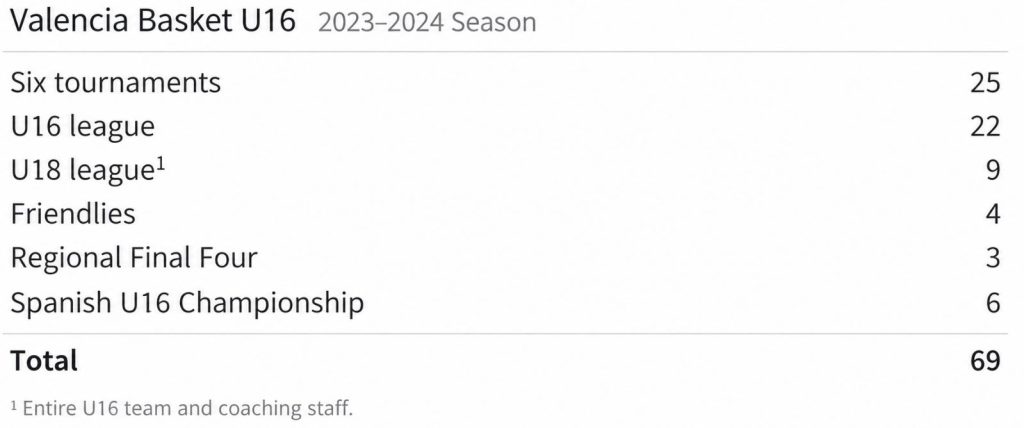
The ordinary U16 league accounted for just 22 games. Quite similar as in other countries. Most of the difference came from everything around it.
Those nine U18 games deserve an explanation. Our entire U16 team entered those games together, with our own coaching staff. Some of our best players also joined the club’s U18 team individually. As happens in many clubs across Europe. Those additional appearances are not included here.
We took some heavy defeats against the older teams.
Across Europe, we complain about youth games finishing 130–20 and ask federations to provide better competition. Playing up gave our whole group access to greater resistance. But it also required us, as a coaching staff and a club, to accept losing. Sometimes badly.
Of course, competitiveness is also present in how Spanish teams practice, from the warm-up onwards. But the competition calendar gives players repeated opportunities to put those habits to the test.
That is where the tournaments matter.
A tournament asks you to recover from a poor performance and play again the next day. To prepare for a different opponent with little time. To handle a game where defeat means going home. To make a decision on a final possession with everything at stake.
Not every game is close. But across six tournaments, a regional Final Four and a week-long national championship with 32 teams, those situations keep coming back.
Two minutes left. A one-possession game. A bad call, a missed free throw, a decision you would like to take back. And another possession to play.
Players get opportunities to make mistakes in those moments, live with the consequences and face something similar again.
And 69 was still not the complete calendar for every player.
Over the Christmas break, most of my players would also compete in Spain’s national championship for regional teams (“Comunidades”). Each region selects a 12-player roster and a coaching staff. A preparation camp, two friendlies and six championship games, including knockout rounds. Different teammates, a different staff and another opportunity to make decisions under pressure.
None of these additional games are included in those 69.
Then, a few months later, summer arrives.
Now imagine Spain facing a team like Belgium in a European Championship quarter-final. Two sixteen-year-olds meet, but they may arrive with very different competitive experience. One may have faced elimination several times that season, across different teams and tournaments. The other had far fewer opportunities.
We watch the final possessions and admire the Spanish player’s composure.
Tournament mentality, we say.
There is certainly a culture behind it.
Clubs and coaches have choices to make. Federations have a responsibility too: to build competition structures that give young players repeated opportunities to compete under pressure.
Before we ask why our players struggle in decisive moments, perhaps we should ask another question:
How often have we given them the opportunity to learn to handle those moments?