Why continuity matters … Lessons from Paris Basketball
If you have been watching Paris Basketball for long enough, a pattern starts to emerge.
Different seasons, different rosters, different coaches.
Yet their game feels strangely familiar.
The pace remains high. The shooting chart barely changes. Offensive rebounding is never negotiable. Even playcalls seem to remain unchanged.
At some point, the question “What is this coach’s philosophy?” shifts to “Who is really shaping the project?”.
Paris Basketball does not feel like a team built around personalities. It feels like an idea that predates the coach and survives him.
Behind that continuity sits David Kahn, whose role goes beyond the traditional European definition of a sporting director. The style of play is defined first, and coaches are recruited because they fit it — not because they are expected to reinvent it.
It is no coincidence that this profile-driven approach echoes what I wrote recently about what might be the most under-scouted position in European basketball.
Most observers recognize this continuity in obvious areas: tempo, spacing, shot selection. What is far less visible happens in the coach’s office.
And that’s where I started looking.
I analysed every Paris Basketball game of the last 4 years at play-by-play level, focusing on one simple variable:
“How long players stay on the floor, and how tightly those rotations are controlled.”
The evolution is striking.
In EuroCup 2022–23, under Will Weaver, Paris sits in the middle of the pack: stints of 6.34 minutes, with a standard deviation of 3.82.
That changes completely in EuroCup 2023–24 with Tuomas Iisalo. Average stints drop sharply to 4.17 minutes, and variation collapses to 1.83. From that point on, Paris becomes the clear outlier — and league leader — in short, tightly controlled rotations.
Promotion to the EuroLeague in 2024–25, under Tiago Splitter, does not soften that approach. If anything, it confirms it: 3.83 minutes per stint, with a 1.81 standard deviation, again among the shortest and most stable in the league.
This season, in EuroLeague 2025–26, with Francesco Tabellini, the pattern reaches its most extreme point so far (Round 17 included): 2.83-minute stints, with a 1.18 standard deviation. This builds directly on my previous article on Paris and Valencia breaking conventional EuroLeague rotation patterns.
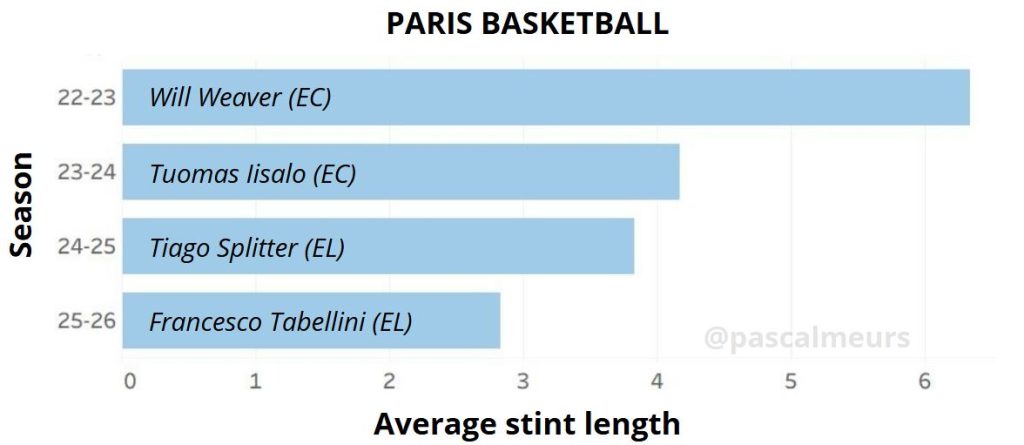
Shorter stints signal intensity. Lower variation signals a fixed rotation pattern, independent of fouls, hot hand or result.
Together, they explain how Paris sustains high pace and aggressive offensive rebounding without burning out its players. Since Iisalo, Paris has not just played fast — it has systematically engineered the conditions to keep doing so.
This continuity has also turned Paris into a launchpad for coaches. Will Weaver moved on to the NBA as an assistant, while Tuomas Iisalo and Tiago Splitter both left Paris to become NBA head coaches. Different personalities, different paths — but the same underlying ideas travelled with them.
However, what works so well in Europe does not always translate seamlessly across contexts.
That tension is already visible. In Memphis, Ja Morant has hinted at how difficult it can be to find rhythm within very short stints — a subtle but telling signal from a star accustomed to longer runs and greater autonomy. For Tuomas Iisalo, the real challenge in the NBA will not be analytical, but cultural: whether a data-driven system built on intensity and efficiency can be fully embraced by players whose status has traditionally reshaped the system around them.
Paris Basketball has shown that continuity can be a competitive advantage. But it has also revealed the other side of that advantage: systems must eventually negotiate with people. While Paris was clearly overachieving over the past two seasons, this year feels different — not as a failure of the system, but as a reminder that even the most coherent ideas are eventually tested by context.
The best coaches are not diminished by structure. They operate at a higher level because of it — knowing when to follow the plan, and when the moment demands flexibility.
That balance, more than the numbers themselves, is where the real story lies.
And indeed, I noticed also some subtle changes in the rotation pattern in their last 4 games. But that’s for a next article.
