The practice our players deserve
When Ettore Messina was asked once about Greg Popovich’s greatest skill as a coach, he didn’t hesitate:
“He excels at singling out the one detail he wants to practice.”
Because in the NBA, teams hardly practice — they play, recover, and travel. He was great in selecting the one detail he wanted to focus on during practice.
During my recent season in CIBACOPA (Mexico), we played 4 (!) league games per week. Four!
In that rhythm, every minute on the floor becomes gold.
I quickly realised that the key isn’t how much you train, but what and how you train.
In my previous article, I wrote about how data can help us single out what deserves our time.
This one today is about HOW we train it.
Super Mario and the comfort of repetition
When I was a kid, I had one video game: Super Mario Bros. Simple, fun — and always the same.
You start in Level 1, you face the same mushroom, the same bomb, at the same time and the same spot.
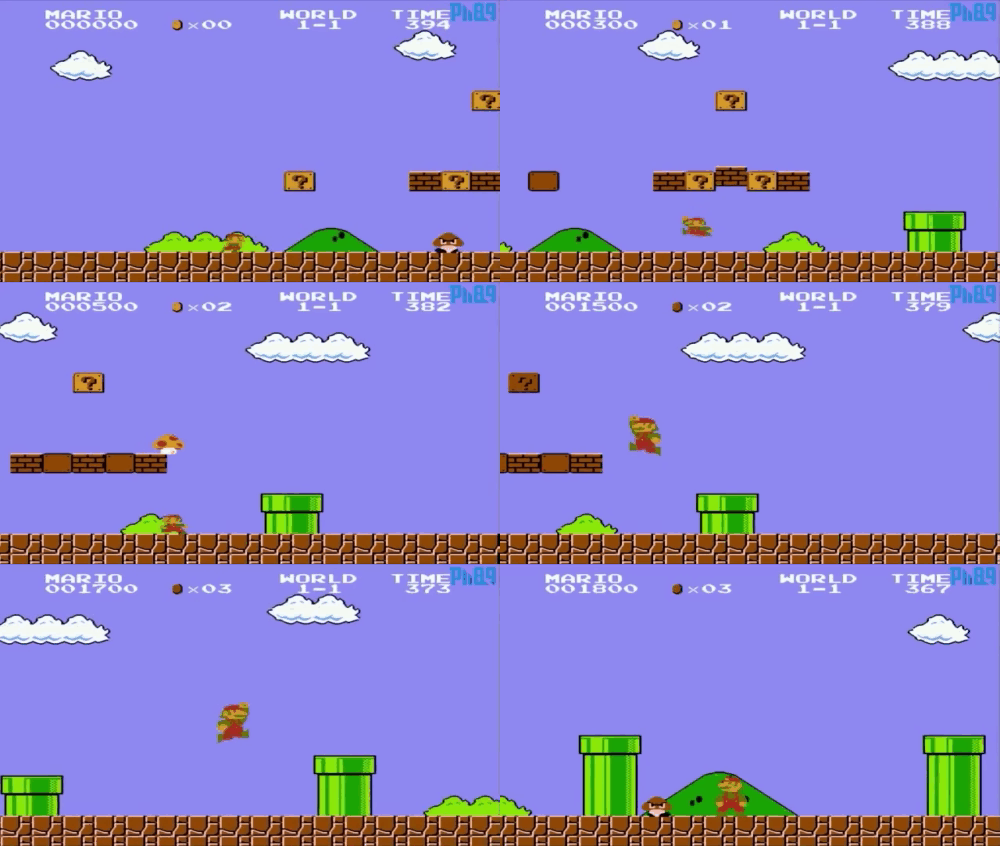
Looks familiar?
A lot of basketball practices look exactly like that.
Lay-up lines, defensive zig-zag line, passing drills, 11-man drills, ballhandling work — predictable, linear, safe.
No decisions, no contact, no context.
Just movement for the sake of movement.
We call it ‘fundamentals’. But maybe, just maybe, it’s nothing more than Level 1 on repeat.
Week after week we see our players improve at … executing a drill.
A new generation, a new learning model
Today’s players grew up in a different world.
Coaches are frustated that kids seem more addicted to videogames than to basketball.
They go all-in for Fortnite — because nothing ever looks the same twice. Every situation changes, every decision matters. That’s what keeps them hooked.
Basketball should feel the same. The game itself is chaos.
Every possession in a game is unique. Every read, slightly different.
The players who thrive are the ones who can adapt.
In my practices, I try to bring a bit of that Fortnite flavour.
Not by turning training into a video game, but by creating conditions where no two possessions look alike.
How to add Fortnite flavour to your drills
It doesn’t require rocket science.
Just small, conscious tweaks that turn repetition into learning:
Add a defender. Even a passive one. It forces a decision. And adds a competitive component.
Keep it real. Make drills look like what actually happens in a game: advantage, pressure, reaction.
Mix environments. Slightly change the context every few reps — different cues, spacing, timing or finishes.
When you do this, players stop executing drills. They start solving game-like situations. And they get better in taking in-game decisions.
I already shared before this pimped version of the 11-man drill which I presented at a clinic in Valencia:
The series of ideas on finishing at the rim which I shared in my most recent articles (here and here) are other good examples which check a lot of the boxes of Fortnite.
The evolution of coaching
A few years ago, I already wrote about this comparison.
Back then it was a metaphor; today it feels like a necessity.
The modern player learns differently — faster, shorter, more visual, more reactive.
So our coaching should evolve in the same direction.
The goal isn’t to make practice feel like Fortnite. It’s to make learning feel alive again.