How Paris and Valencia break the system… A new way to manage minutes

Coaching in the CIBACOPA League in Mexico earlier this year confronted me with a very real problem.
We played 4 (!) games a week, often with long travel journeys, while running the highest pace in the league. That combination forces you to manage players’ load with almost scientific precision. Every minute too long on the floor becomes a small tax you pay later in the week.
EuroLeague teams face a similar reality today. With two new clubs added, the schedule has never been heavier — especially for teams that also play in a demanding domestic league. And yet, only two teams approach this challenge in a fundamentally different way: Paris Basketball and Valencia Basket.
That contrast became impossible to ignore on November 21st, in Olympiakos vs Paris.
The game had barely started when, 2 minutes and 56 seconds in, Paris substituted their entire five-man unit. Five out, five in. And less than three minutes later: again.
Only shortly after, coach Bartzokas of Olympiakos made his very first substitution of the night.
By the end of the game, the numbers looked absurd:
– 69 substitutions for Paris
– 19 for Olympiacos
And still, not a single player on either side played more than 28 minutes.
The distribution of minutes was similar — the method could not have been more different.
For me, that was the signal to investigate.
My curiosity took over.
I wrote a script to run through every substitution of every EuroLeague game played so far this season.
What emerged was a clear pattern:
-
Average stint length at Paris: under 3 minutes
-
Average stint length at Olympiacos: over 8 minutes
But that’s not all of it.
Even more remarkable is what happens when we look at the variation of those stints.
I calculated the standard deviation per player, because some players naturally have longer stretches and others shorter ones, depending on role, position and game plan. On that level, Paris sits at an average of less than 1 minute.
In simple terms:
“a random substitution at Paris typically deviates only about one minute from that player’s ideal rotation length“
Most EuroLeague teams show much larger swings.
A high deviation usually means the coach is rotating on feel — the hot hand, early fouls, momentum, fatigue, a good or bad possession.
Paris does almost the opposite.
Players follow a fixed substitution pattern, one that reacts surprisingly little to in-game events. Fouls, mistakes, momentum swings — they matter far less than the system behind them.
And when you plot every team on a graph — average stint length on one axis, variability on the other — two dots sit all alone in the bottom-left corner: Paris and Valencia: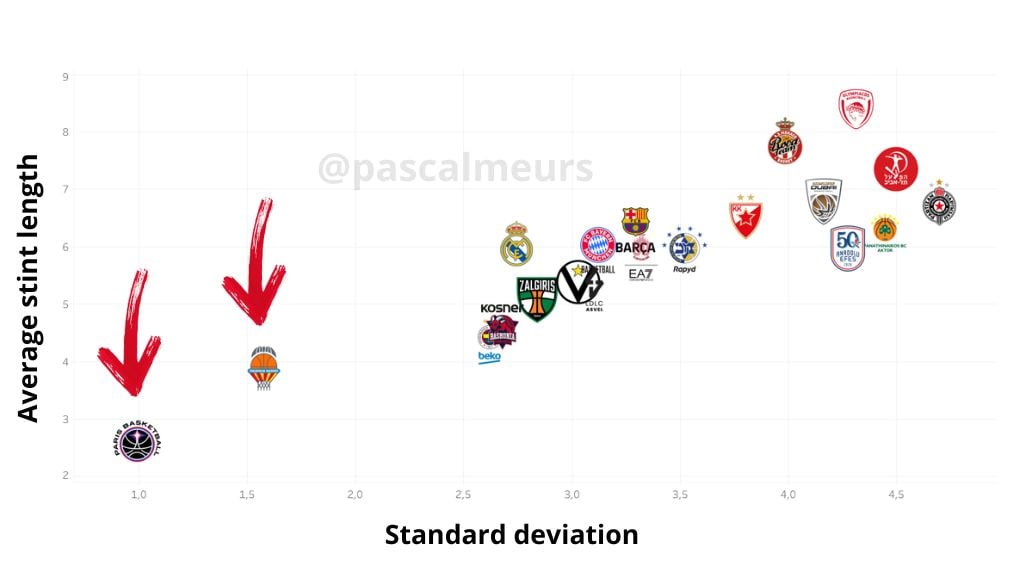
Both teams play with the highest pace in the EuroLeague.
Both manage load not by extending benches or cutting minutes, but by using short, predictable, standardized rotation patterns.
Patterns that stay stable night after night.
For transparency: in my analysis I removed end-of-quarter stints lasting only one or two possessions. They distort the data but say little about a coach’s underlying rotation model.
So what does all of this tell us?
Not that one style guarantees success.
Olympiacos won that game.
But Paris and Valencia show something else: a new way to manage minutes in the modern EuroLeague. A way built on data and patterns rather than instincts.
And maybe that is the real difference between Paris, Valencia, and the rest. Their rotations aren’t reactions to the emotions of the game.
They are a system — one that runs even when the game tries to pull you into chaos.
Analytics won’t make you win every single game. But it removes the guesswork behind the decisions you take.