The Paradox of Game-Like Shots
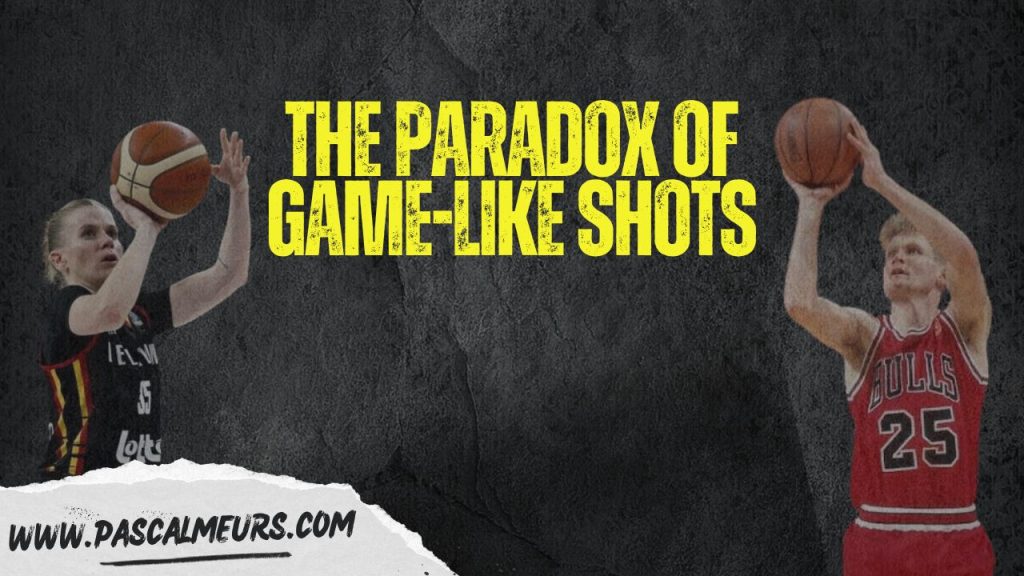
As coaches, we often talk about taking game-like shots. You play like you practice, right?
Recently, I came across a video of Belgian guard Julie Vanloo taking extra shots on her own after practice. She was wearing headphones.
She wasn’t listening to music though. Instead, she had really loud arena noise playing in her ears.
The idea was simple: to make every shot feel a little more like a game. Game-like, you could say.
There is still plenty of discussion about whether something such as “muscle memory” really exists. But perhaps there is something even more important at work here.
One of our main responsibilities as coaches is to give players the confidence that they can execute during games. Experiencing a situation in practice before they face it in competition can help create that confidence.
It reminds me of a story about Steve Kerr.
Kerr was one of the NBA’s best shooters in the 90’s, but he also had one of the most specialized roles in basketball. He could spend a long time on the bench before suddenly being called into the game.
Taking hundreds of consecutive jump shots at practice didn’t resemble that reality at all.
So shooting coach Chip Engelland approached the problem differently.
Instead of feeding Kerr ball after ball, they sat together on the bench during individual sessions. They talked. Sometimes Kerr read a newspaper.
Then, without warning, Engelland would yell: “GO!”
Kerr sprinted onto the court, received one pass and took one shot.
Then he returned to the bench.
They repeated the cycle for about thirty minutes.
Sit. Wait. One shot. Back to the bench.
Kerr took only seven shots during the entire workout. It sounds almost absurd.
Yet those seven shots probably resembled the shots he would take in an NBA game far more closely than the hundreds of repetitions that fill most shooting workouts.
That, to me, is the paradox of game-like shots.
The most game-like shooting session might contain fewer shots, not more.
When I was preparing Valencia Basket’s U16 team for the Spanish Championship, I faced a similar challenge.
One of our players had a role that resembled Kerr’s. He wasn’t expected to play heavy minutes. More often than not, I would bring him into the game for one specific reason: to make a shot. Often after a time-out.
The circumstances of a team practice didn’t allow me to recreate Engelland’s sessions with Kerr.
But during the final weeks before the national championship, I found another way to prepare him for that moment. Sometimes, when the team stopped for a water break, I would suddenly shout across the gym: “PEDRO, TRES!”
Everybody immediately knew what was coming.
Pedro would step onto the court and inbound the ball. We would run our sideline play, and he would come off the screens exactly as he would during a game.
He would catch my pass and take one shot.
Then practice continued.
We repeated it two or three times during each practice in the final weeks leading up to the Campeonato de España.
It wasn’t about volume. It was about familiarity and confidence. When players repeatedly experience moments that genuinely resemble competition, those moments become less unfamiliar when they eventually happen in a game.
Maybe that is what game-like practice is really about.
Not only copying the movement or the shot, but also recreating the circumstances and the feeling around it.
A few years ago, I spent a week working alongside NBA shooting coach Dave Love during individual sessions with elite EuroLeague players.
How he approached game-like shooting is a story for another article.
In the meantime, enjoy summer!

Thanks for the mention Coach. I’m working on a paper about a similar paradox that we face around representative practice for weak shooters.
And I’m curious how much I’d still support the work I did 5 years ago, and how much I’d push back on.
Keep up the great work.
Ik vind dit weer een heel mooi stukje. Ik ben ook erg bezig met het ´game-like shot, want dat stationaire schieten is goed voor ritme en gevoel. Maar wanner heb je in de wedstrijd zoveel tijd en plaats??? Mooi, altijd weer nieuwe denkmomenten. Groeten