The Pace Trap – Why speed often backfires
We are in the middle of the FIBA windows.
For many clubs, this is one of the rare moments in the season to step back — to evaluate, to compare initial ambitions with the reality of the standings, to reflect on identity.
One buzzword keeps appearing in those conversations: pace.
Across Europe, more and more coaches want to play faster. They look at Valencia. They look at Paris. They see volume, energy, early attacks — and they assume speed is the cause.
But speed is rarely the cause. More often, it is the by-product.
Take Manresa in the Spanish ACB.
They play at the highest pace in the league this season. No team pushes the game faster. On the surface, it looks aggressive. Modern. Relentless.
And yet, their position in the standings invites a deeper look.
Many coaches try to increase pace in order to generate more shots. But on average, Manresa finishes games with two fewer shots than their opponent.
How is that possible for the fastest team in the league?
Because speed increases possessions for both sides.
And when pace is not supported structurally, it exposes weaknesses. Only two teams in the league commit more turnovers than Manresa. On top of that, no team allows more offensive rebounds.
If you play fast but fail to control the ball and secure the defensive rebound, tempo does not create advantage. It magnifies imbalance.
Pace is not the goal.
If you add five extra possessions to a game, your opponent gets five extra possessions too. You have changed the rhythm — not the margin.
That is the trap.
Below is the mid-season Shot Differential per 40 minutes in the ACB:
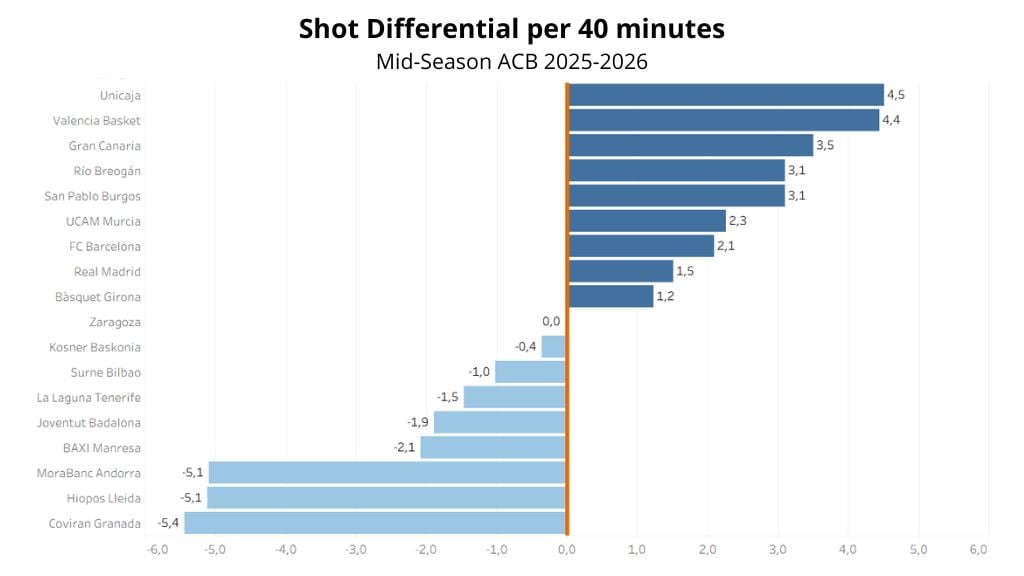
Unicaja and Valencia generate roughly +4.5 shots per 40 minutes more than their opponent. That is substantial. Over a full season, it compounds into structural separation.
Yet they arrive there in completely different ways.
Valencia leads the league in offensive rebounding, recovering 37% of their own misses. Every extra rebound becomes an extra shot. Their full-court pressure further increases possession volume.
Unicaja, on the other hand, sits in the middle of the pack offensively on the glass. But they are by far the best defensive rebounding team in the league. They deny second chances. Different philosophy, same outcome: positive shot differential.
This is the key distinction.
The battle is not about absolute pace. It is about relative possessions.
If structure does not generate extra shots — or prevent them — tempo alone only makes the game louder.
This is exactly the interaction I explore in more depth in my mid-season ACB report, Patterns, Pace and Pressure, where I analyse how shot volume, shot quality and rotation patterns interact across the league:

So why is everyone talking about pace? Is it overrated?
Not at all.
When implemented within structure, higher tempo can create better scoring opportunities. It can increase efficiency. But without control, it simply adds noise.
In the end, winning still comes down to two conditions:
Have more shots than your opponent.
Convert them at a higher rate.
Everything else feeds those two.
The FIBA window is a good moment to ask an uncomfortable question:
Are we playing fast — or are we actually winning the possession battle?